Orion capsule 'biopsied' during performance research
HUNTSVILLE, AL (WAFF) - Think "CSI" meets "Grey's Anatomy," and you have an idea of what types of investigative methodology went down Tuesday at Marshall Space Flight Center in Huntsville.
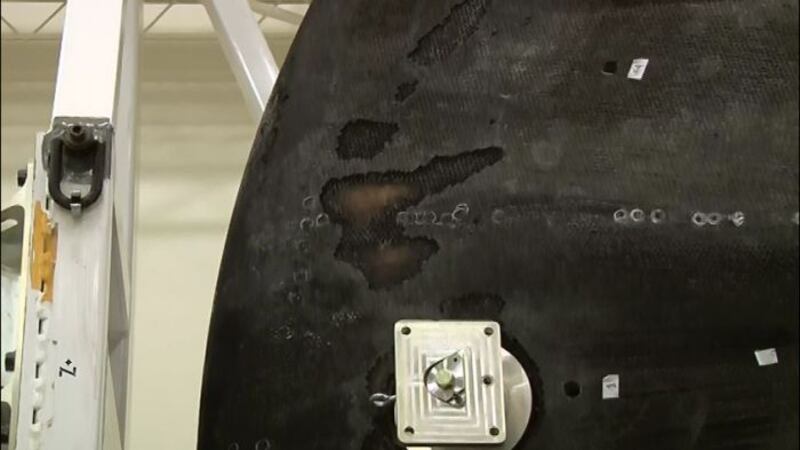
The heat shield from the December launch of the Orion crew capsule is in the Rocket City to be "biopsied."
Its black aft coating was shaved-off with surgical precision, so NASA can see how it performed while enduring 4,000-degrees Fahrenheit over it's 3,600 miles in deep space.
MORE: Orion EFT-1 launch coverage
The crew capsule's heat shield already has lots of divots, pock-marks and holes with numbers by it - and it's about to get a lot more .
It's all part of Marshall's investigation to see how the thermal protection system performed.
Lockheed-Martin Orion project manager Terry Abel explained why the forensic examination is so precise and so necessary.
"The capsule entered at a unique orientation, not flat-bottom, so it would sort of cut into the atmosphere, and of course, splashdown," Abel said. "(On) those locations, we have material laid up a different thickness to accommodate the anticipated environment; the heat at that location. We want to see the real data compared to what we predicted so it will get better. It is for subsequent missions; it's paramount that we keep our astronauts safe."
MSFC Orion Project Manager Larry Gagliano said had a crew been on board the capsule's test launch, it "would have done its job and and brought the crew home safely."
Orion's heat shield will be at MSFC for the next two months.
Tuesday, those who worked on it actually got a chance to see it and take their pictures with it.
Folks from other NASA centers are also in Huntsville to join in the process of using Marshall's very unique 7-Axis Milling and Machining Tool to get the tedious job of shaving the shield done.
From here, Orion faces a few more tests before it can be cleared for a flight on top of NASA's deep-space rocket, the Space Launch System, in 2018.
Copyright 2015 WAFF. All rights reserved.